Lebanese Women and Children in Al-Hol: When Time Becomes a Violation
Date posted
Khaled W. Al Sabbagh
Attorney & Strategic Specialist
For years, the file of Lebanese women and children detained in Al-Hol camp has been stuck in a grey area between silence and neglect. What they face is no longer a mere urgent humanitarian crisis, but a continuous violation of rights that tests the Lebanese state’s commitment to its responsibilities towards its citizens.
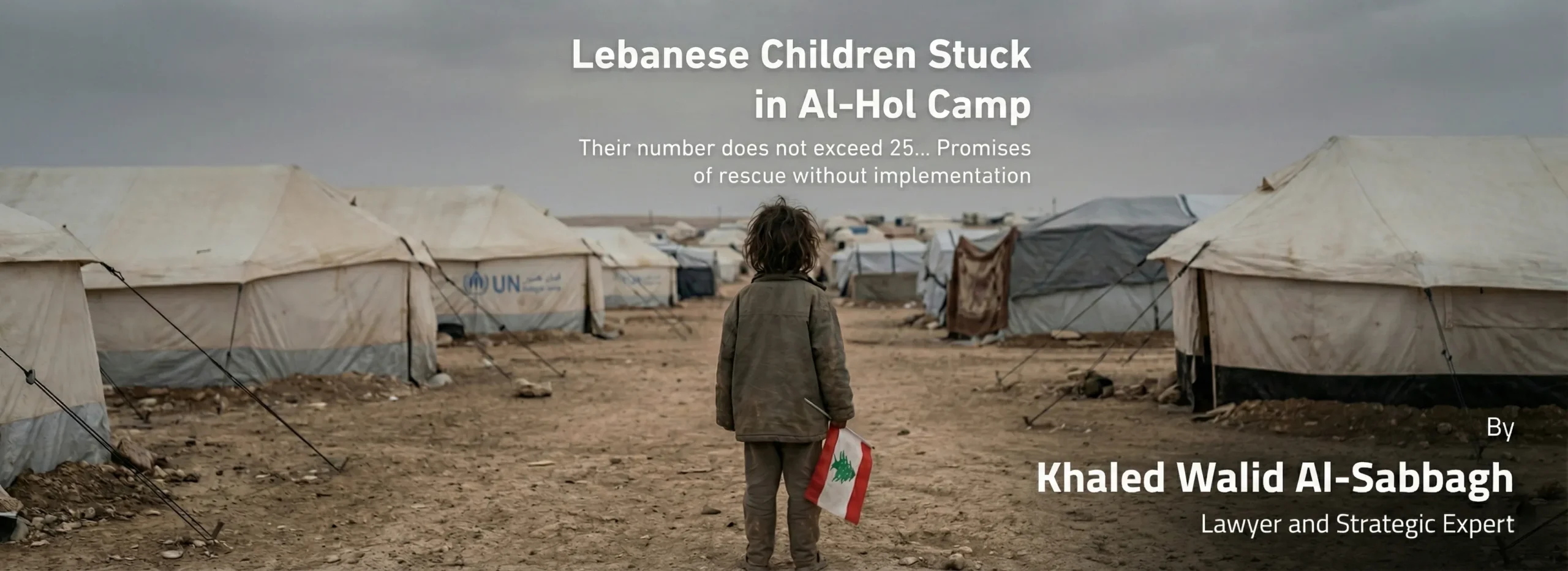
Al-Hol camp is not just a place. It is a space where childhood is suspended, and rights are emptied of their content. Thousands of women and children have lived for years in conditions described by international organizations as degrading and unsafe. Among them is a limited number of Lebanese women and their children, whose detention is not subject to any clear judicial process, but rather to the absence of a political decision.
The paradox is that this file, despite its sensitivity, is one of the simplest in terms of size and complexity. The number is known, the identities are confirmed, and the nationality is not under dispute. Nevertheless, their return has remained pending.
In recent months, this silence has begun to crack.
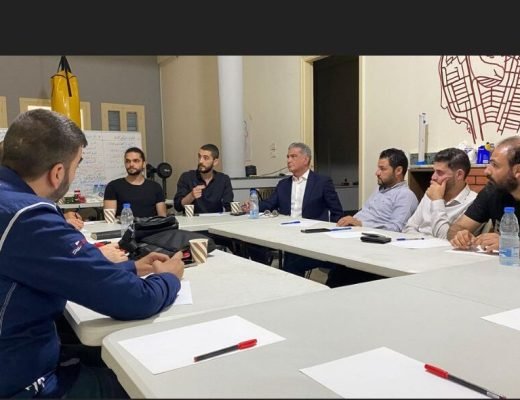
During a meeting with Prime Minister Judge Nawaf Salam, in which I personally participated as a member of the Lebanese Coalition for Sovereignty and Transitional Justice, the file of Lebanese women and children in Al-Hol camp was addressed from the perspective of the state’s responsibility and its constitutional duty toward its citizens. The Prime Minister showed a clear awareness of the seriousness of the issue and an openness to approach it as a purely human rights matter. The discussion also reflected an understanding that sovereignty is not limited to the exercise of formal authority but is embodied in the state’s ability to protect its citizens beyond its borders when their fundamental rights are subject to long-term violation.
However, this openness has not yet translated into decisive executive steps.
At the institutional level, the file still clashes with overlapping jurisdictions, administrative hesitation, and the absence of a collective decision, which has allowed some official bodies to continue refusing cooperation. Thus, a solvable humanitarian file has turned into a chronic state of rights violation due to obstruction, not incapacity.
Into this vacuum, the role of human rights defenders emerged.
Lawyer Mohammad Sablouh played a pivotal role in transferring the issue from the local framework to the international arena. In addition to his legal follow-up inside Lebanon, he recently visited Geneva, where he held a series of meetings with UN Special Rapporteurs and international mechanisms concerned with human rights. These meetings focused on the arbitrary nature of the detention of Lebanese women and children in Al-Hol camp, the Lebanese state’s obligations under international law, and the necessity of activating international protection frameworks given the failure of internal solutions.
These meetings contributed to the inclusion of the issue within broader UN concerns, including arbitrary detention, the rights of the child, enforced disappearance, and the protection of human rights defenders. Thus, the issue is no longer just a humanitarian appeal, but has become a file with an international legal dimension that requires follow-up and accountability.
This international momentum parallels a clear field reality: the Kurdish authorities supervising the camp have repeatedly affirmed their readiness to cooperate and hand over the detainees immediately upon receiving a clear official request from the Lebanese state. This means the obstacle is not external, but primarily internal.
From a legal perspective, the obligations are clear. International law obliges states to repatriate their citizens from arbitrary detention, especially women and children. From a transitional justice perspective, these individuals are considered victims of conflict and institutional neglect, not parties to a crime. Justice begins with their repatriation, rehabilitation, and reintegration, not by leaving them in isolation and oblivion.
In an interview with social worker Nahla Baroudy, who works with cases of trauma, violence, displacement, and reintegration, she explained that women and children returning from Al-Hol camp often face “the effect of complex traumas” resulting from living long-term in an environment of deprivation, instability, and constant fear. This can manifest as sleep disturbances and nightmares, severe anxiety, panic attacks, attention deficit, learning difficulties, and withdrawn or aggressive behavior in some children, in addition to feelings of stigma and insecurity among the mothers. She added: “The priority upon return to Lebanon is a safe and humane reception without defamation, followed by an individual psychological-social assessment for each case, and the development of a support plan that includes specialized trauma-focused psychological treatment, support for mothers in parenting skills under pressure, and the gradual reintegration of children into education within a prepared school environment. Health follow-up, legal and social support, and the involvement of the family in the care plan must also be provided, because reintegration is not a single moment but a process that requires protection and continuity. The most important thing is to build a community protection network that reduces stigma and grants them a real opportunity to restore their lives and dignity.”
What is at stake today goes beyond this file itself. It is a test of the state’s ability to translate declared commitments into coordinated action, to confront institutional obstruction, and to replace administrative paralysis with accountability.
The required steps are clear and need no interpretation:
An official decision for repatriation, effective governmental coordination, a humane reception plan, and a transparent review of the previous course of negligence. Every day of delay not only increases the suffering of women and children but also compounds the loss of trust in institutions.
The repatriation of Lebanese women and children from Al-Hol camp will not be merely the closure of a pending file, but a message that the Lebanese state is capable of exercising its sovereignty as an authority that protects rights, confronts obstruction, and understands that deferred dignity is violated dignity.